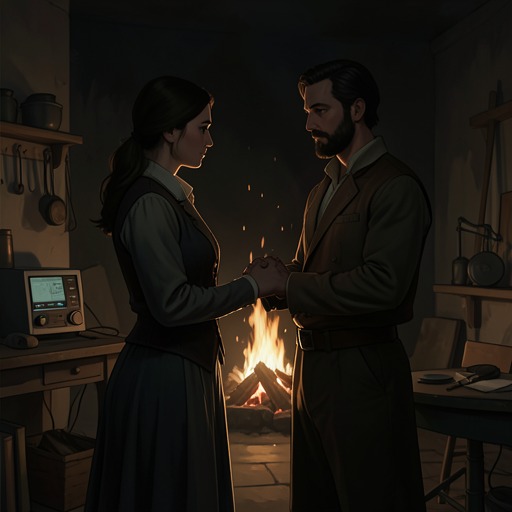
Malorie and Tom
Bird BoxMalorie and Tom’s relationship joins practical trust to an attachment that becomes most visible through absence. In the Shillingham house, Tom’s problem-solving helps organize collective survival, while Malorie comes to understand how much the household—and she herself—depends on him. When he is gone, remembered words and actions sustain her, but their force also reveals the cost of his repeated willingness to take risks for the group.
A bond formed in the household
When Malorie first arrives at the house, Tom asks about what she encountered on the drive: a dead dog, a mail truck, empty streets and storefronts, and an abandoned car with a jacket. His curiosity suggests a practical interest in information that might help the household, while Malorie feels that the details she can offer are insignificant. Their early connection thus sits within a community trying to interpret a changed and dangerous world, not apart from its daily demands.
The household’s survival depends on shared work and improvised safeguards. Its members have food stores, including canned goods gathered before the first reported incident in the Upper Peninsula, but those supplies are finite and become more strained with Malorie’s arrival. A bucket and well-rope routine is conducted under blindfold, with a housemate listening indoors in case something goes wrong. In this setting, care takes concrete forms: vigilance, labor, and attention to what the group may need next.
Tom’s proposals reflect that collective orientation. He suggests protective helmets for the blindfolded people who might go out, butcher knives as a defense, and dogs on leashes as guides, with the group prepared to release an animal if it becomes dangerous. His plan makes the risks plain even as it tries to manage them. Malorie’s relationship with Tom develops in a household where mutual dependence is inseparable from decisions about how much danger to accept.
Trust, leadership, and risk
Tom’s concern for Malorie becomes explicit when he urges her to take a leadership role during a later expedition. Before he and Jules leave, she tells him that the house may not be able to withstand his not returning. Tom answers that they will come back, then turns her attention from her fear to the group’s needs: she should remember that they returned from the previous trip and help others when they become scared. He also reminds her that the household needs medicine and sterilization supplies because she is close to giving birth.
The exchange shows two different but connected understandings of responsibility. Malorie focuses on Tom’s personal absence and the emotional and communal loss it would cause; Tom frames the expedition as part of a shared obligation. He insists that the house needs everyone, not only him. His reassurance does not erase the danger. Rather, it asks Malorie to act amid uncertainty and to draw on the fact of their earlier return.
The three-mile walk gives that tension a precise shape. Tom and Jules leave after reviewing the map with Felix. Olympia gives Tom a Petoskey stone she says has always brought her luck, and Gary encourages the men. Malorie, despite the importance of the departure, says nothing, does not hug Tom, and does not say goodbye. The closed front door makes the unspoken farewell consequential: only hours later, she is pained by her silence, remembering that the previous expedition brought back children’s shoes while knowing that the present journey reaches into what she regards as the most dangerous landscape in the world.
Absence and remembered guidance
The relationship continues in Malorie’s recollections after the household’s immediate scenes have given way to her river journey. In a moment of exhaustion and danger, she yearns for Tom more intensely than before. The remembered presence is not a new physical rescue; it is an inner point of orientation. As wind, cold water, animals along the banks, bodily strain, and the grayness that confines her attention press in, Tom comes to her as something bright, right, and good.
His remembered voice is associated with thinking through the next action and continuing to row. The contrast is central to their bond: in the house, Tom turns fear into plans and assignments; on the river, his memory helps Malorie keep moving when he is absent. The relationship therefore persists as practical guidance as well as affection. His encouragement has particular weight because he had already asked her to help others through fear and to recognize the household’s need for collective leadership.
Meaning and limits of the bond
Tom’s willingness to leave again exposes the strain built into his care for Malorie and the household. He is attentive to her imminent need for supplies and urges her to lead, yet he also accepts another dangerous absence in order to advance the group’s chances of survival. Malorie understands both sides: she knows why the medicine matters, but she also fears what his failure to return would mean. Her unspoken goodbye and later regret hold those obligations together without resolving them.
The relationship’s force lies in this conjunction of the intimate and the communal. Tom is not only someone Malorie longs for; he is a person whose practical judgment and organizing efforts have become part of how the household endures. Conversely, the household’s dependence sharpens the personal stakes of his departure. Along the river, where Malorie must act without him, memory preserves his significance but cannot remove the dangers or make the journey certain. His absence makes the bond newly visible: it is both a source of endurance and a reminder of how much can be lost when survival repeatedly requires someone to leave.